Models & data API
MuPIF follows an object-oriented design. Abstract classes define standardized interfaces for models and for data, so all models can be steered through the same generic interface and all data of a given kind can be used in the same way, regardless of where they come from.
One interface for every model
Every simulation code is wrapped as a Model with a common API. Its main methods are
initialize, set and get for inputs and outputs, solveStep, finishStep,
getCriticalTimeStep and terminate. A workflow is itself a model, so workflows can be
nested and reused as building blocks of larger workflows.
The coupled thermo-mechanical workflow below passes the temperature field computed by a thermal model to a mechanical model. The two models may use different meshes and may run on different computers:
class ThermoMechanical(mp.Workflow):

    def solveStep(self, istep, stageID=0, runInBackground=False):
        thermal = self.getModel('thermal')
        mechanical = self.getModel('mechanical')
        thermal.solveStep(istep, stageID, runInBackground)
        # pass the temperature field to the mechanical model
        mechanical.set(thermal.get(mp.DataID.FID_Temperature, istep.getTime()))
        mechanical.solveStep(istep, stageID, runInBackground)
Data types with built-in operations
-
Properties
Scalar, vector and tensor quantities with units, constant or time dependent.
-
Fields and meshes
Spatial fields on meshes, with evaluation at any point and interpolation between different discretizations. Fields can be exported to VTK.
-
Heavy structured data
HeavyStructstores large hierarchical data (molecules, grains, microstructures) in HDF5, with its structure described by a schema. -
Physical units
All quantities carry units, based on astropy. Units are checked and converted automatically when data are passed between models.
-
Files
PyroFiletransfers input and output files between remote models transparently. -
Time steps
TimeStepobjects synchronize models that use different time discretizations.
Metadata and the core ontology
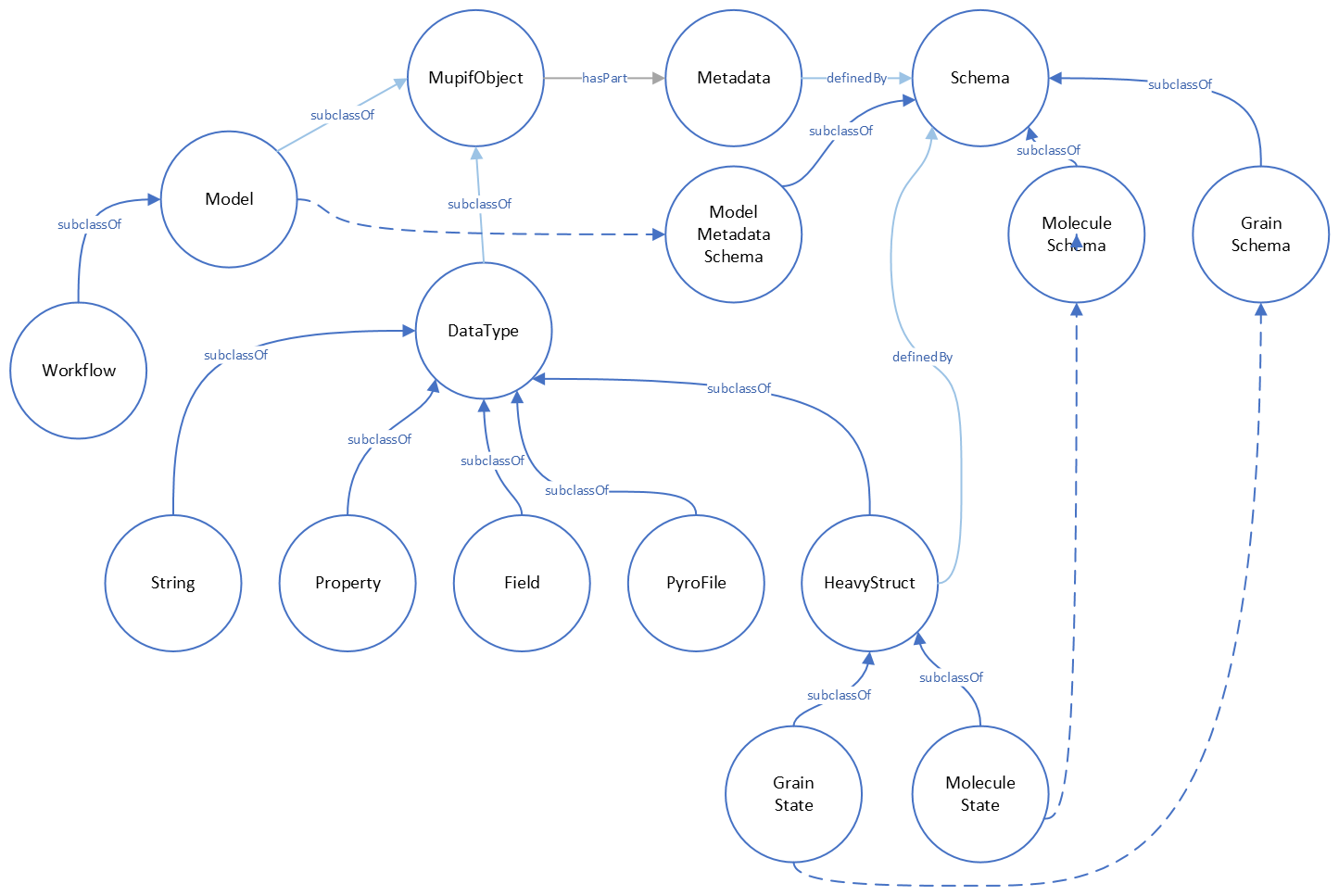
Models, workflows and data carry metadata validated against JSON schemas. The metadata describe inputs and outputs (type, units, value type), the solver, licences, and the expected accuracy and robustness. They are used for model registries, automatic checks of workflow consistency, code generation in the workflow editor, and for mapping workflow inputs and outputs to the Digital Twin.
Codes already integrated
MuPIF model interfaces (APIs) have been developed for a range of commercial and open-source codes. The list below includes codes integrated by project partners:
| Code | Domain |
|---|---|
| COMSOL Multiphysics | general multiphysics |
| Abaqus | structural finite element analysis |
| Digimat | multiscale material modelling of composites |
| ESI VPS | virtual performance solution |
| MICRESS | microstructure evolution (phase field) |
| GTM-X | glass furnace CFD |
| FDS | fire dynamics |
| MUL2 | higher-order structural theories |
To integrate your own code, implement the Model API in a small Python class. The Model API generator creates a skeleton from the model metadata. See the Model API development tutorial.
 (since February, 2023)